One document, everything in it
Chapter two of the scour book.
A job is an HCL document a client submits. It carries its own engine configuration, so nothing is inherited from whichever server picks it up, and a job resubmitted next month does what it did today.
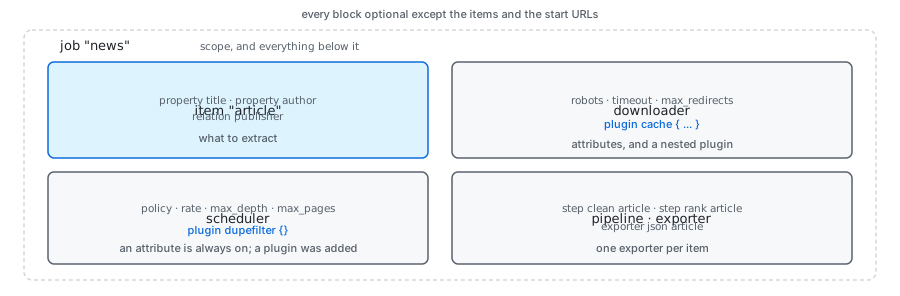
Attributes and plugins
An attribute is behaviour the stage always has. There is no meaningful "off" for a request timeout, no meaningful position for it in an order, and nowhere else it could have been written.
A nested plugin is something you added. It reorders, it turns off, and somebody else can write it.
That division is what stops a setting drifting away from whatever enforces it.
A max_body kept in a different block would be a number the downloader might
or might not be reading, and the way you would find out is by downloading four
gigabytes.
It also removes the stage label from plugins. The block a plugin is written in
says which chain it joins, so the two cannot disagree. And the scheduler block
simply has no external attribute, which makes writing one a parse error with
a line and a column rather than a rule buried in a validator.
The rule that follows from it
Obligations are attributes, not plugins. A crawl with no cache is a valid crawl that costs you money; a crawl with no robots handling harms somebody else's server. A thing whose absence hurts a third party must not be opt- in through a mechanism that defaults to absent.
What one looks like
job "news" {
  domains  = ["example.com"]
  start    = ["https://example.com/topic"]

  item "article" {
    property "title" {
      type       = str
      required   = true
      transforms = [text, trim]
    }

    property "author" {
      type   = entity
      entity = "person"
    }
  }

  scheduler {
    policy      = "priority"
    rate        = "2s"
    concurrency = 2
    max_depth   = 3
  }

  downloader {
    robots        = true
    timeout       = "30s"
    max_redirects = 10

    plugin "cache" {
      backend    = "s3"
      bucket     = "pages"
      access_key = secret("acme-s3-key")
      secret_key = secret("acme-s3-secret")
    }
  }

  exporter "json" "article" {
    dir = "./out"
  }
}
Bare words like str, entity and text are a predeclared vocabulary rather
than strings, so a misspelling is a parse error pointing at the character
rather than a value that silently means nothing. Everything else is an
ordinary HCL string: policy = "priority" is a value the scheduler checks
against a list, not a word the parser knows.
A long list can live in a file beside the document
domains, start, included and excluded are the four fields that grow.
A seed list of three thousand URLs pasted into a job is a document nobody can
read, review or diff, and those lists are often generated by something else or
shared between jobs.
job "news" {
  domains = lines("domains.txt")
  start   = lines("seeds.txt")

  item "article" {
    property "title" {
      type = str
    }
  }
}
One entry per line. Blank lines and # comments are skipped, which is the
reason the format is not simply "split on newlines": a seed list somebody
maintains has notes in it saying why a URL is there.
The file is read where the document is, and once. The path resolves against the document's own directory, so a job and the lists beside it move together, and never against whoever happened to run the command.
What the cluster stores is the list, not the reference. scour job create
resolves the files and submits the entries, because nothing in a cluster can see
the author's machine. This is the same rule the whole format rests on: a job
document carries everything one crawl needs, so a job resubmitted next month
does what it did today. A stored job that still said lines("domains.txt")
would mean whatever that filename happened to point at on whichever node picked
it up, and two nodes would crawl different sites with nothing to say so.
So a document read without a directory to resolve against refuses lines by
name rather than guessing, which is exactly the position a node is in when it
reads a stored job. Expanding touches only the attributes that use the
function: the rest of the file is submitted byte for byte, because the diff
between two submissions is the whole of what a resubmission is reviewed by.
A plugin's configuration is nobody else's business
Everything inside a plugin block is left undecoded until the plugin is
built. The engine never learns what bucket means. That is what lets somebody
else write a plugin without changing anything here, and it is why a field the
plugin does not recognise comes back as an error with a line and a column
instead of being ignored.
It also makes secrets safe for free. secret("acme-s3-key") is an unevaluated
function call everywhere the job travels: the document submitted, the copy
stored, the diff shown when it is resubmitted, the output of scour show. It
becomes a credential exactly once, on the node building that plugin, and
nowhere it could be written down.
Submitting the same name again
A job resubmitted under a name that is already running mutates it. What that costs depends on what changed, and the document says in advance what it is willing to pay:
| Change | Effect | Because |
|---|---|---|
| A new start URL | Free | Adds work, invalidates none |
| A tighter budget | Free | Nothing already done becomes wrong |
| A narrowed scope | Costly | Queued URLs are now out of bounds |
| A changed item shape | Costly | Records were read under the old one |
| A moved cache | Costly | The corpus is somewhere else now |
A costly change is refused by default. A mutation block is how a job says
otherwise, and what to do with what the change invalidated: drop the out-of-
scope URLs or keep them, discard the stale records or re-extract them from
bodies already in the cache.
Every item shape carries a fingerprint that changes exactly when the shape does, and every record says which fingerprint it was read under. Reordering properties or renaming a job does not move it; adding an entity reference does. That is what makes "which records are stale" a question with an answer rather than a guess.