Chains run both ways
Chapter three of the scour book.
A chain wraps its stage rather than hooking it, so every link sees the request
on the way out and the response on the way back, in opposite orders. That is
what makes order mean something, and it is the part that is easy to get
wrong.
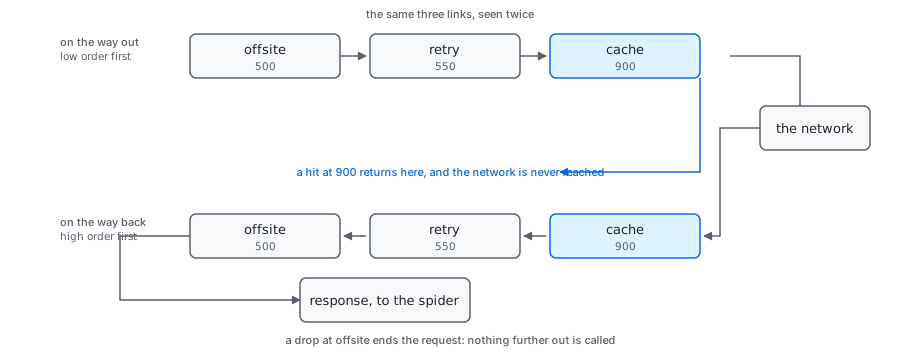
The numbers are Scrapy's, because copying a known-good ordering is cheaper
than rediscovering it, and the reasoning transfers with them. cache at 900
is the last thing before the network, so a hit short-circuits the fetch only
after every other request middleware has had its say: a URL the offsite rule
would drop is dropped whether or not it happens to be cached.
Two things every link may do
Short-circuit: return a result without calling the rest. A cache hit is this and nothing more.
Drop: return ErrDrop. Refusing a URL out of scope is this. It is a
sentinel rather than an ordinary error because a dropped request is a normal
outcome of a working crawl, and counting it as a failure would make every
politely behaved crawl look broken.
Both are in the contract from the start because neither can be added to it later without changing every link ever written.
They also fall out of wrapping rather than needing anything added. The
alternative shape, a pair of Request and Response methods, is worse in
three ways: it needs a convention for a link that wants to short-circuit, it
makes a link that needs state across the two directions stash it somewhere,
and it cannot express "run this on the way back even though the way out
failed", which is what a timer and a stats counter both want.
func timing(next Handler) Handler {
    return HandlerFunc(func(ctx context.Context, req *Request) (*Response, error) {
        started := time.Now()               // on the way out
        resp, err := next.Handle(ctx, req)
        log.Println(time.Since(started))    // on the way back
        return resp, err
    })
}
From a list of names to a chain that runs
The job document can say a job wants a plugin called cache at 900. The chain
machinery can run an ordered set of middleware. Neither of them can answer
whether cache is a thing that exists.
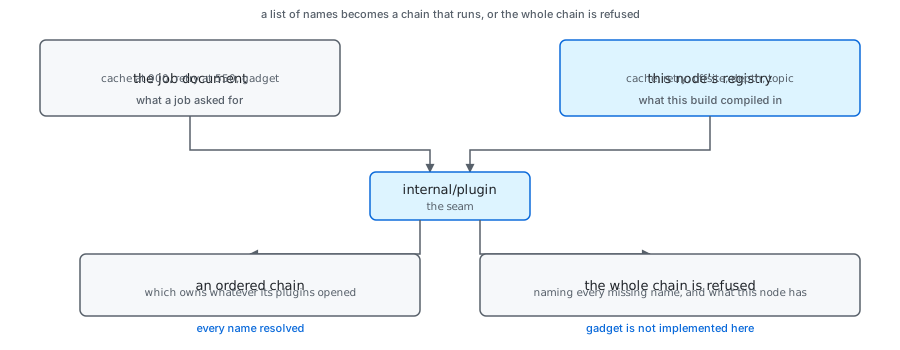
Every missing name is reported at once, along with what the node does have. A job loading six plugins on a node with four of them should be told which two, not sent round the loop twice.
The chain that comes back owns whatever its plugins opened. A cache plugin
holding a bucket has nowhere to put a Close, because what a plugin hands
back is a function and a function has nowhere to keep a method; so it
registers one with the chain, and the chain closes them last opened first when
the job stops. A chain refused halfway closes what it had already opened
before it returns, because the caller has no chain to close it with.
Where middleware conventionally sits
A catalogue of positions, not a list of working parts. A name in it is a claim about where something would go if it existed. What exists is what a registry says exists, and that is asked when a chain is built.
| Order | Downloader | Order | Spider |
|---|---|---|---|
| 500 | offsite |
50 | httperror |
| 520 | contenttype |
300 | topic |
| 543 | cookies |
500 | offsite |
| 544 | auth |
700 | referer |
| 550 | retry |
800 | urllength |
| 560 | headers |
900 | depth |
| 580 | metarefresh |
||
| 610 | proxy |
||
| 850 | stats |
||
| 900 | cache |
Not in the table
Decoding, robots and redirects. Each of them has exactly one correct position, and a position that can be configured is a position that can be configured wrongly. The next chapter is about what that means for a request.
Back: One document, everything in it · Next: Fetching, politely