Fetching, politely
Chapter four of the scour book.
The downloader is a core that does one HTTP request and a chain around it. What surrounds the chain is not configurable, because being wrong about it harms somebody else.
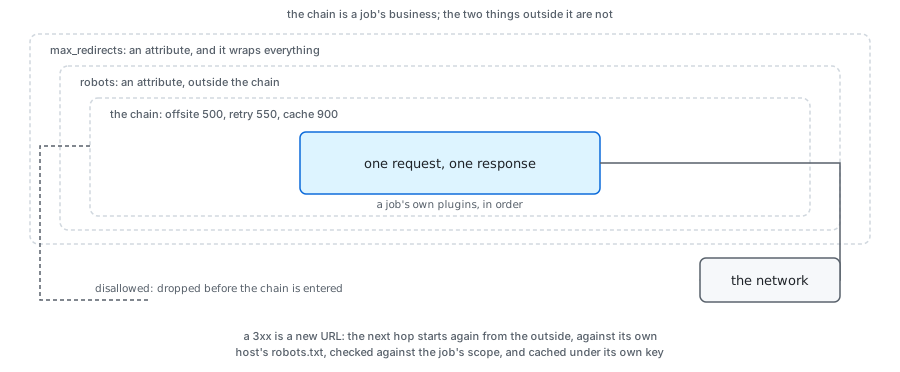
The core
One request, one response. The user agent, the timeout and the body limit live here because none of them has a meaningful "off" and there is nowhere else they could be written.
A body is refused on its declared length first, so a link to a video costs the headers rather than the video. The read is bounded separately, because a chunked response declares nothing and a server may simply lie. One byte over the limit is read on purpose: without it, a body of exactly the limit and a body of a gigabyte are the same read, and the only way to tell them apart is to have read the gigabyte.
The timeout covers reading the body, not just the headers. A server that answers instantly and then dribbles a body for an hour is the case a header- only timeout does not catch.
A status nobody wanted is still a response. A 404 comes back with its
status and its body rather than as an error, because whether a 404 is a
failure is the spider's decision and httperror is where it is made. An error
from the downloader means the fetch did not happen at all: no connection, no
answer, a body over the limit, a context that ran out.
robots.txt
It wraps the entire chain, so a refused URL is refused before the cache is consulted and before a retry is scheduled. A job can turn it off, which is legitimate against a site you own; it cannot quietly move it behind the cache, which never is.
The file is fetched with the bare fetcher rather than through the chain. Through the chain it would be checked against robots.txt, which is a loop, and it would land in the page cache, where it would be served back long after the site changed its mind. What a site permits has to be current. A success is kept for the life of the job on this node; a failure is not kept at all, so a network blip costs one request rather than a host.
| robots.txt answers | Which means |
|---|---|
| 2xx | The rules, as written |
| 4xx | A site with nothing to say. Most sites |
| 5xx | A site that could not tell us, which is not a site that said yes |
| nothing | The same |
RFC 9309 is implemented here rather than imported. Being wrong has a victim: a parser that is subtly too permissive crawls what a site asked it not to, on somebody else's machine, under our name, and nothing in our own output looks wrong when it happens. That is a thing to read the specification for and hold to a test suite.
The rule the whole file turns on is that the most specific match wins, by pattern length, and an allow wins a tie. A site writes a broad disallow and then allows the one directory it wants crawled:
A case worth knowing
Given
Disallow: *.gif$andAllow: /publications/, a gif under/publications/is allowed: fourteen characters beat six. A site that meant otherwise has to say so with a longer pattern. This is the answer RFC 9309 requires, and it is not the one most people expect.
Which agent the rules are read for
The one the request is about to be sent under, not the one the job configured.
A request may carry its own User-Agent - a middleware setting one is
supported, and rotating them is why - and the guard used to check the job's
agent while the wire carried another. A site that disallows acmebot and
allows everybody else was read as allowing, and the disallowed path was then
asked for with User-Agent: acmebot. Refused by name, fetched anyway, and the
site's log shows one agent asking for the rules and another ignoring them. The
parsed file is agent-independent and cached per host, so asking about the right
agent costs nothing and re-fetches nothing.
Escapes compare without regard to case
RFC 3986 says a percent-encoding compares case-insensitively, and both sides of
this comparison are written by somebody else: the publisher's escapes in the
rule, and the site's own in the links it serves. Compared byte for byte,
Disallow: /müll/ did not match a link written /m%c3%bcll/page, so the
crawler fetched a path the site had refused; a lowercase rule and a
normally-encoded link failed the same way. Only the two hex digits after a %
are folded, because a robots.txt path is case-sensitive everywhere else.
The one thing in the file this stage cannot act on
Crawl-delay is read here and honoured somewhere else. Politeness is per host
and decided in the frontier, and these are two stages that may be on two
machines, so a number read here has to travel to be worth reading at all.
It rides back on the response, and over the bus in the fetch reply, as a delay per host rather than one for the request: a redirect chain reads the robots.txt of every host it passes through, and each of those sites asked for something. The scheduler is the one place that knows which of them it has already recorded, so that is where the list is deduplicated and handed to the frontier. What the frontier then does with it is the next chapter but one.
Redirects
An HTTP client will follow redirects for you, and one it followed would be
invisible to everything above: the cache would hold the final body under the
original URL, and a redirect to another host would fetch that host's pages
without anyone reading its robots.txt. So the client is told to hand 3xx back,
and max_redirects decides what happens next.
Following wraps everything, robots included. Each hop re-enters the whole
downloader from the top: checked against its own host's rules, through every
middleware, cached under its own key. Setting max_redirects = 0 follows none
and hands the 3xx back.
Credentials do not follow a redirect off the host. They were given to one site, and this is exactly how they end up somewhere they were never meant to go. On the same host they are kept, or a login would not survive the redirect that every login ends with.
303, and 301 and 302 for anything that had a body, become GET, because that is what every client does and therefore what every server expects. 307 and 308 exist because they do not.
A loop is not a drop. A site that redirects in a circle is broken, and counting it as politeness would hide that, so it is an error naming the trail it went round.
A hop is checked against the job's scope before it is taken. The scheduler drops an out-of-scope URL before it is queued, and a redirect happens after queueing, so the scheduler has already had its say and cannot have another. Without a check here a job naming one exclusion followed a redirect straight past it, which is worse than an ordinary scope leak: every other URL a crawl considers went through the one place that decides, and this one did not. An out-of-scope hop is a drop rather than a failure, because it is the ordinary outcome for a URL outside the scope and not a sign anything went wrong.
What this will still become
A redirect that leaves the host is followed inline, which is right for the same-host case and is nearly all of them. Turning an off-host hop into a frontier request instead would give dedup and politeness a say in it as well. Scope already has one.