The cache is the corpus
Chapter five of the scour book.
Fetching is the expensive, rate-limited, impolite part of crawling. Understanding a page is neither. Keeping the bodies is what lets extraction be re-run, and re-run again after a change to how it works, without asking a site for the same page twice.
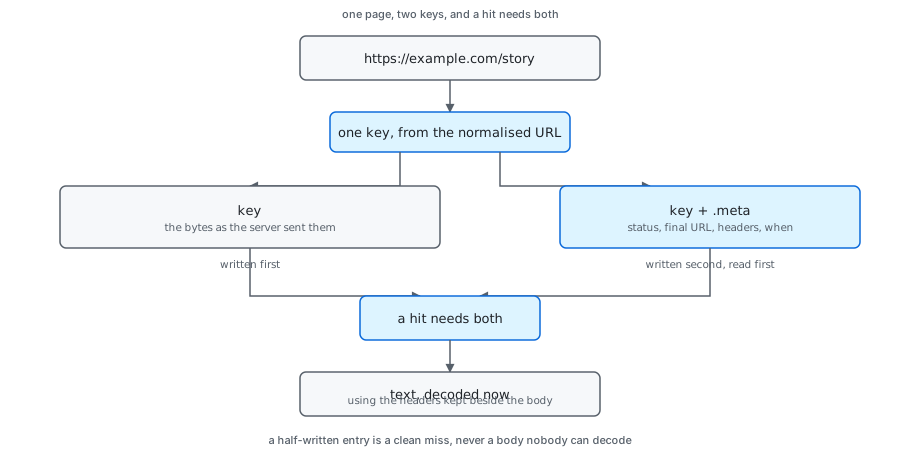
What is stored, and why in two keys
The cache itself is deliberately dumb: a key maps to bytes, and nothing else. That is what lets the same interface be a directory on a laptop and a bucket shared by a fleet, with the local filesystem, S3 and Google Cloud Storage behind one contract that all three are held to by the same test suite.
What the key is derived from is the middleware's business too, and it is not always the URL. An ordinary GET keys on the URL alone, which is every fetch a crawl makes and every entry already on disk: the cache is the corpus, and a key that changed would make every corpus anybody has unreadable overnight. Anything else - a form post, a HEAD - keys on its method and body as well. They were left out, and the key is what decides whether a request is answered from disk, so two posts of one form with different terms shared an entry: the second was answered with the first's results, marked as a hit, and never sent to the site.
Using two of those keys per page is the middleware's business and none of the
store's. The sidecar exists because a body on its own is not re-readable. A
page in windows-1251 that declared its encoding in the Content-Type header
and nowhere else decodes correctly on the way in and into mojibake on the way
back out.
This could have lived in the records database instead. It lives in the cache because a corpus that cannot be read without a second database that happens to still exist is not a corpus.
The body is written first. A hit needs both and reads the sidecar to decide, so an interrupted write leaves an entry that is a clean miss, never a sidecar promising a body that is not there.
What the cache holds is what the server sent
Not decoded output. That is the more useful archive: detection improves, and original bytes can be decoded again to get a better answer, while a corpus decoded on the way in has its mistakes baked in until somebody re-crawls. It is smaller, too, and faithful enough to revalidate.
The cost is that every read decodes. For a corpus re-analysed a few hundred pages at a time that is nothing, and it buys the ability to be wrong about an encoding and fix it later.
A decision that was reversed
Decoding was briefly a middleware, sitting at 600 so that what landed in the cache was already UTF-8. That was wrong twice over: it baked today's detection into the archive, and it only applied to bodies read through the downloader's chain, while the spider reads the cache directly by key and never passes through it. It is now a function both callers use, and the cache holds what arrived.
A cache that fails does not fail the crawl
A read that errors is a miss. A write that errors is logged and dropped. Losing a page that was successfully fetched because the disk that was only ever an optimisation filled up is a bad trade, and the fetch has already been paid for by then.
What a job can say about it
| Setting | Default | What it decides |
|---|---|---|
backend |
local |
A directory, an S3 bucket or a GCS bucket |
bucket, prefix |
none | Where in it, so one bucket can hold several corpora |
ttl |
never | How old a hit may be. The difference between an archive and a monitor |
statuses |
[200] |
What is worth keeping. A 404 says a URL is dead today, and caching it would keep saying so after the page came back |
None of the credentials appear here. A cloud backend that needs one reaches
for secret("name"), which is resolved on the node building the plugin and
nowhere the job was written down.