Four stages and a bus
A book about the engine, in ten chapters. Every claim in them is checked against the code by a test, so a chapter that drifts fails the build.
A crawler that ranks links by how likely they are to hold what you asked for. The parts are borrowed from Scrapy; what differs is that they are services talking over NATS rather than objects calling each other, and that a job brings its own engine with it.
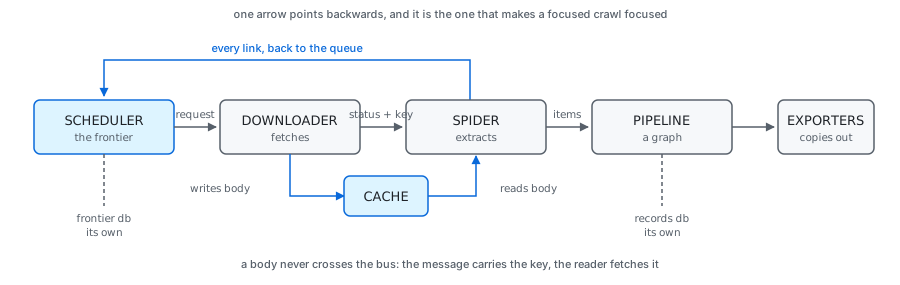
Read it left to right and the shape is ordinary: something decides what to fetch, something fetches it, something reads what came back, something does the work on what was read. Four stages, and the exporters at the end.
Three things about the picture are worth more than the boxes.
Only one arrow points backwards
Every link a spider finds goes back to the scheduler, and the scheduler decides what comes out next. That loop is where a focused crawl differs from an exhaustive one: an exhaustive crawler can use a queue, because it is going everywhere anyway and only the order changes. A focused crawler is choosing what not to fetch, and that choice happens in the one place every discovered URL passes through.
A body never crosses the bus
The message from the downloader to the spider carries a status and a cache key. The body itself went down into the cache, and the spider reads it back out by that key.
That keeps a megabyte of HTML off the message bus, which matters at any real rate. It also means two different things read a body, which is why turning bytes into text is a function both of them call rather than a link in either chain: a decode that lived in the downloader's middleware would apply to the downloader and not to the spider, and the corpus would be UTF-8 only when it happened to be read the long way round.
The scheduler is the one stage a job may not replace
Any other stage can be handed to somebody else: a spider written in Python that subscribes to the bus is a first-class spider. The scheduler cannot be, because politeness is per host and shared. Two schedulers handing out the same host cannot honour a crawl delay between them, so there is one decision point per host and that settles it.
Where this is
All four stages are built and tested, and so is the bus between them:
scour runcrawls a job in one process and the same job produces the same records wired either way. What is not built is driving a crawl across the cluster, and applying a change to a job that is already running. The last chapter lists the lot.
Contents
The book runs in one direction: what a job is, how a request is made, what comes back, and what is done with it. Each part is a stage of that.
Start
- One document, everything in it
An HCL job carries its own engine, so nothing is inherited from whichever server picks it up.
Fetching · one request, wrapped in what a job asked for, inside what a site asked for
- Chains run both ways
Middleware wraps a stage, so every link sees the request going out and the response coming back. - Fetching, politely
The core fetch, robots.txt, and redirects that re-enter from the outside. - The cache is the corpus
Bodies are kept because understanding a page is cheap and fetching it is not.
Choosing what to fetch · the one decision that makes a crawl focused
- What to fetch next
The queue is the crawler. Ordering it is most of what focused means.
Extracting · what a page turns into
- Shapes, entities, measurements
What is extracted, what it refers to, and what it becomes when it flows. - A graph, not a list
Steps run when what they require has run, and exporters each write one item.
Running it
- Local until it has to be shared
Twelve commands, the loop they make, and the line between what runs here and what needs a cluster. - Where everything lives
Eleven stores, each with one owner and one reason to exist.